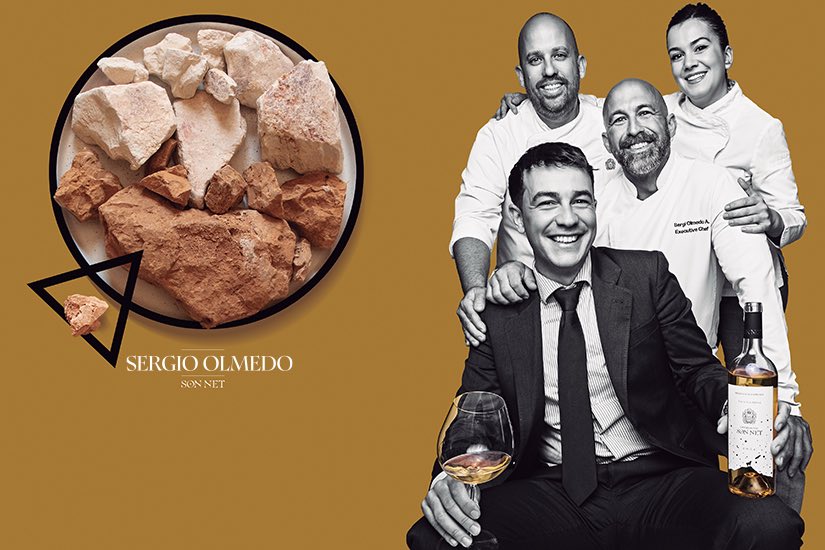
Sergio Olmedo and his team
Sergio Olmedo has been at the helm of Son Net’s culinary offering since 2019, more than enough time for a project to mature, breathe and establish itself. True to the island’s identity, the Mar & Duix restaurant has undergone a quiet fusion process: the gradual incorporation of Italian talent into its kitchens has created such a natural synergy that both cultures seem to speak the same language. Pasta stuffed with Mallorcan cheese, open-fire grills at midday and a strong commitment to local agriculture. Welcome to the haven of the Mallorcan dolce vita.
Sergio, where is Son Net heading right now to continue setting itself apart on the island?
We’re going to keep working along the same lines. We’re building on what we were already doing: striving to develop an increasingly distinctive and mature voice as a restaurant. We want an unmistakable identity. The aim is for anyone who visits to recognise that there’s something truly different about what we offer. We remain committed to the foundations of contemporary Mallorcan and Balearic cuisine. It’s about respecting local, seasonal produce and market-driven cooking, delving into the region’s culinary archaeology.
Along this path, Italy has steadily gained prominence in the kitchens of Mar & Duix. How does this influence fit into a restaurant with Balearic roots?
It has been a very natural process. We’ve had several Italian members of staff in the kitchen for some time now, and we’ve realised that we have a lot in common. We share a pantry, even though the ingredients may differ. What we do is adapt our recipes with nods to Italian cuisine and vice versa. Ultimately, we remain Mediterranean; our essence is rooted in the same trio: olive oil, wheat and the vine. A strong synergy has emerged, and new ideas and dishes are springing up as a result of this daily collaboration.
And in which specific dishes on the menu can we see this collaboration at the table?
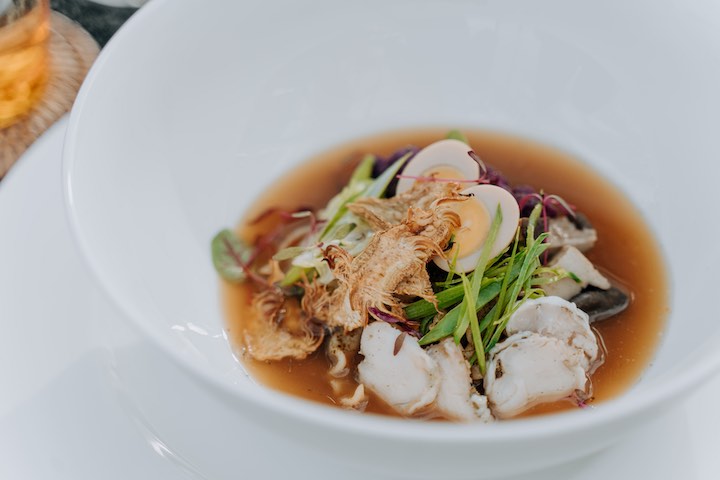
For example, we’ve just introduced a seasonal pasta dish using peas and a local goat’s cheese. We’ve also been working with cappellacci, which is a larger stuffed pasta with a base of preserved lemon. It’s a very fresh, springtime dish that flows naturally from our day-to-day work. We also carry out very occasional experiments with subtle nods to Eastern techniques, such as bao buns. We like the result, but we take care, so to not end up with a jumble of influences from other cuisines that might cause us to lose our identity.
With such a diverse team, how do you manage the creative process?
The creative process works by letting everyone contribute. Obviously, it’s not about having 20 different, nonsensical ideas, but if everyone feels they have a voice and a role to play, we’ll ultimately bring it all together. If we can achieve a balance that makes sense with our philosophy, so much the better.
We aim to convey elegance while maintaining simplicity. We believe that, right now, that’s where luxury lies
At Mar & Duix, you change style from lunch to dinner. What sets these two offerings apart?
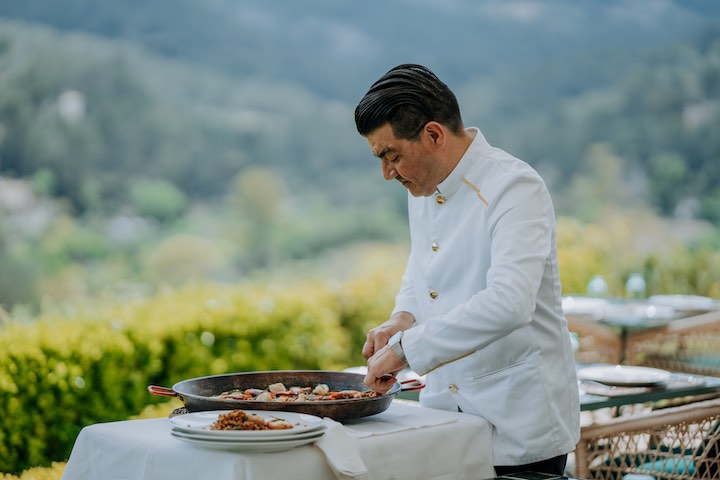
At lunch, we focus more on grilled dishes (we mainly use the Josper) and rice dishes. It’s a market-led, seasonal kitchen where the produce is the undisputed star; we keep it as pure and natural as possible, without masking its true flavour. The evening menu, however, offers contemporary Mallorcan cuisine, with more elaborate dishes. We aim to convey elegance while always maintaining simplicity, because we believe that, right now, that’s where luxury lies. It’s a calm elegance, very much in keeping with the hotel itself, without being ostentatious or trying to overcomplicate things.
Outside the kitchens and that understated luxury, reality is pressing in. How does the situation facing the countryside in Mallorca affect you?
We want to draw attention to the difficult situation currently facing the countryside on the island, both for farmers and livestock farmers. Unless you have your own kitchen garden or resources, it’s very difficult. It was hard before, but now for many it’s downright critical, and I’m talking about the actual situation, not exaggerating. If we lose the local producer, we lose the cornerstone of the whole structure, and no matter how hard we try in the kitchen afterwards, everything will come from further afield and we’ll have lost our essence.
But the bottom line rules in the hospitality industry. Is it financially worthwhile to continue supporting local produce even if profit margins suffer?
We try to uphold the principle of working with local produce at all costs, even though profitability drops significantly. Local produce might cost double or triple the price of goods from elsewhere, and it’s clear that profit margins suffer as a result, but the difference in flavour is unmistakable. We have unique local products that are irreplaceable. Just as the Italians have ’nduja, we have our sobrasada. We can’t set our products aside because, if we do, we’ll end up being just another establishment. I believe that our “big battle” this year is exactly that: being able to keep up the fight.