KANSO
In Japanese, Kanso denotes the beauty of simplicity. A linguistic paradox, really, because stripping a dish back until only its essence remains is perhaps the most complex task in gastronomy. Fleeing the tyranny of tweezers, foam and “unnecessary frills”, Ismael Rojo and Raúl García, the creators of the successful Kaizen restaurant, have opened a Japanese tavern in Palma that is a sound slap in the face to ‘poncey cooking’. No distractions: simply the magnetism of the robata, precise-to-the-millimetre cutting and an almost unhealthy obsession with achieving the near impossible, so that when you take a mouthful, the outside world disappears.
There is an endemic malaise affecting haute cuisine these days: establishments that cost millions, tableware worthy of a museum, armies of chefs with tweezers and dishes that taste of nothing. To break this inertia, Kanso has burst upon the scene, a second project for Ismael Rojo and Raúl García. And its very name expresses its mission.
“Kanso is a spectacular kind of cooking, but without embellishments, foams or needless pretensions”, explains Raúl. If the star of the dish is an aubergine, that aubergine must be cooked to a standard that makes you lose your mind. And to achieve this so-called ‘simplicity’, you need to be a technical expert.
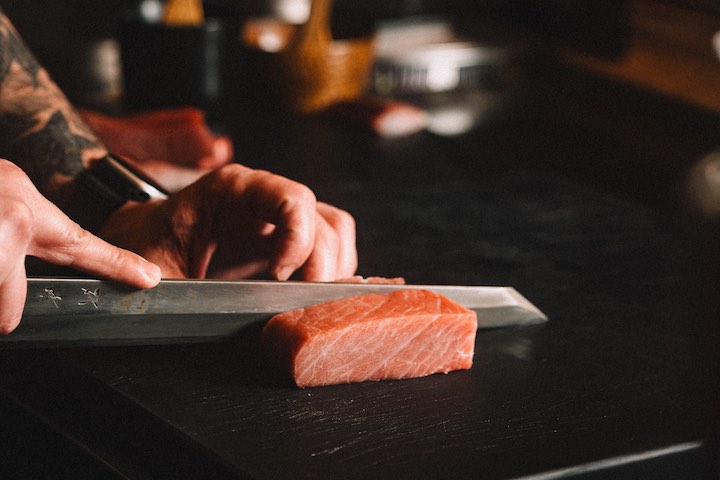
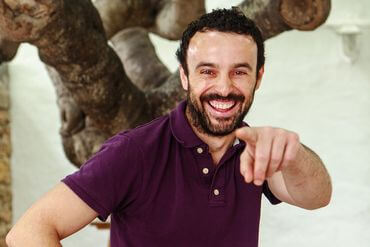
Both men divide their time between working as chefs and as owners. They met four years ago, at the height of the Covid pandemic, and they dived in at the deep end without life jackets to open Kaizen in an establishment with a reputation for being cursed. “We are like yin and yang. Ismael is an itamae (sushi expert), with an unhealthy obsession with details that nobody sees. I am an old-school chef in the French tradition, a tractor that never stops working”, jokes Raúl.
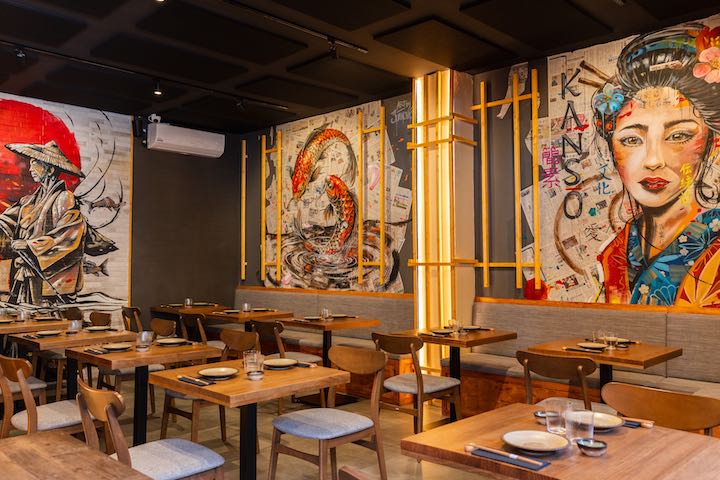
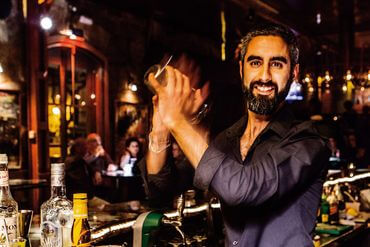
This duality lies at the heart of Kanso. This Japanese-style tavern has freed itself of the tasting menu straitjacket to offer fire, cocktails and an ambience in which taking a seat at the bar is almost a moral obligation. Here the robata (Japanese barbecue) reigns supreme. One example of a dish is belly-fillet of tuna, marinated in soy and garlic, caressed by the flame, and accompanied by parsnip purée, glazed shitake mushrooms, and a touch of wasabi. “This is where Raúl comes in, with his technique for making purées with lots of butter and great depth of taste”, explains Ismael.
And then there are the strokes of genius, such as their reinterpretation of katsu sando: the finest cut of pure Guijuelo Iberian pork (known as secreto ibérico), fried in extra-crispy breadcrumbs, and filled with an egg yolk emulsion, barbecued black onion, foie mi-cuit, wrapped in a toasted and buttered brioche. “These are unctuous, primitive mouthfuls”, say the pair.
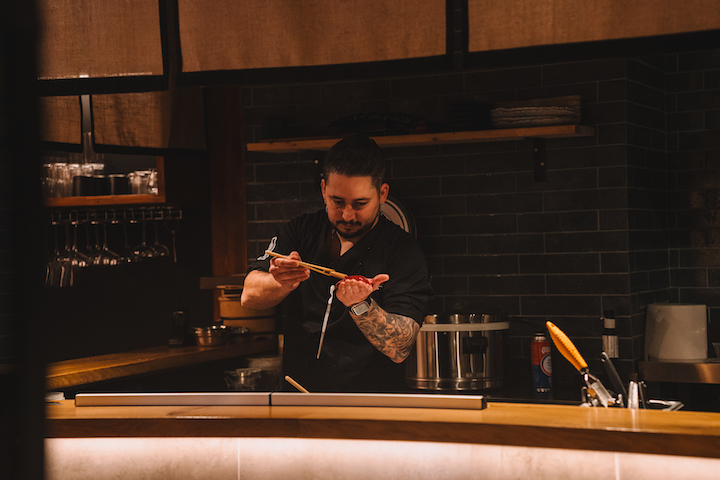
But there’s more to Kanso than smoke and a barbecue grill. At the new restaurant, just like previously at Kaizen, their sushi is something of an passion. From their painstaking selection of the seeds to their obsession with the serving temperature. “Nigiri must be served with the rice at body temperature, 37 or 38 degrees. Only that brings out the fats from the fish. If you serve it cold, it’s like drinking wine straight from the fridge: it doesn’t taste of anything”, explains Ismael.
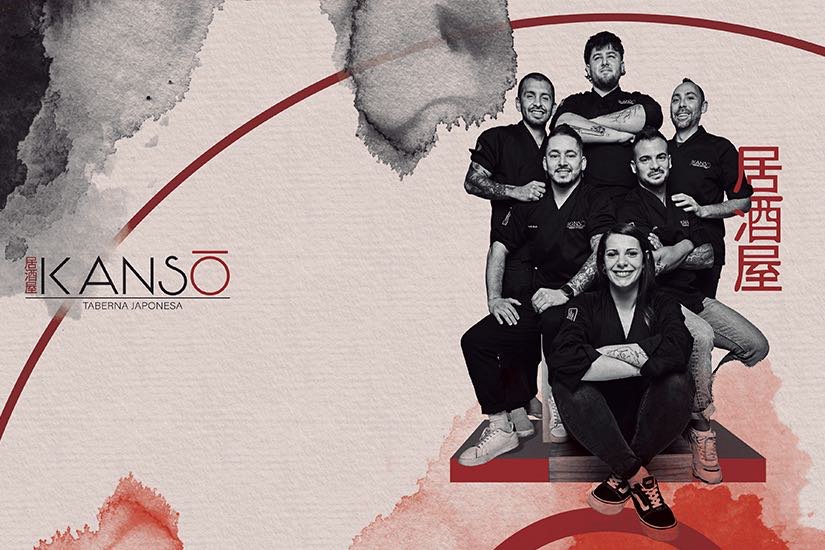
They are not in a hurry to conquer the world, although Raúl and Ismael already have Palma eating out of their hands. Remaining faithful to the philosophy that governed their first project (Kaizen means ‘continuous improvement’), they have based their new restaurant on the same formula: a half-controlled madness rooted in obsession, talent and reverence for umami.